
Embrace It, Don't Shame It: Using AI to Enhance Student Learning and Problem Solving
Universities panicked when ChatGPT arrived. Bans, detection tools, fear of cheating. But the real risk was never the tools. It was failing to teach students how to use them well. Here's how we went from cautious observers to building an entire course around AI-assisted learning.
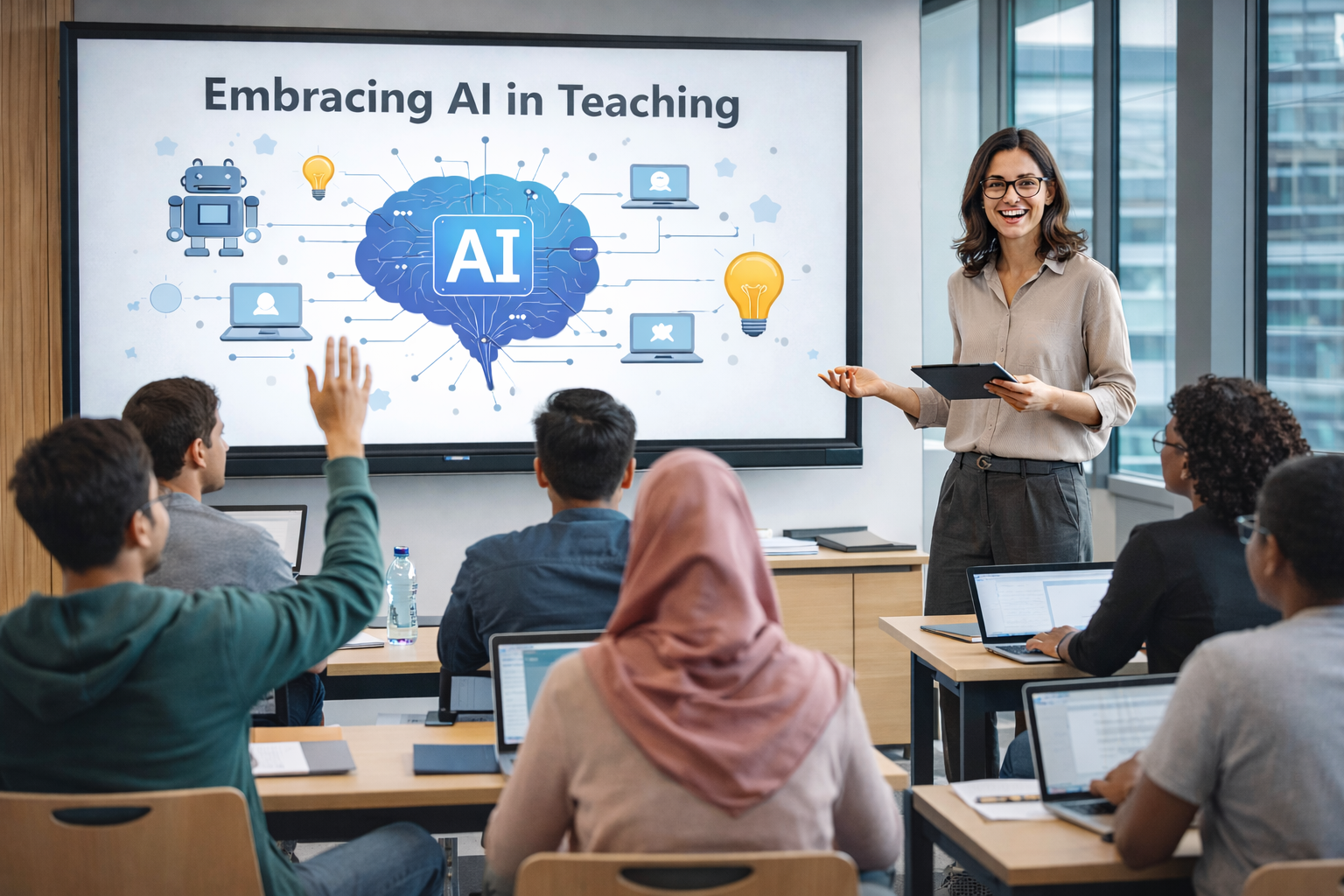
When ChatGPT launched in late 2022, universities around the world had essentially the same reaction. Panic.
Within weeks, institutions were issuing emergency guidance. Some banned AI tools outright. Others rushed to adopt detection software, and suddenly every assignment submission was suspect. The question was never whether AI could be misused. The question was what to do about it. Most institutions chose restriction: banning the tools, leaning on detection software, and in some cases bringing back handwritten exams.
We went the other direction.
From Caution to Conviction
We spent 2023 using these tools in our own work (writing, coding, data analysis), and they genuinely changed how we worked. They worked as thinking tools, helping us iterate faster and get past mechanical bottlenecks. We wrote about this shift in 95% of My Work Happens in VS Code.
But we also saw the other side. Students submitting AI-generated essays with no understanding of the content. Detection tools flagging non-native English speakers as “AI-written” while missing actual AI output.
By 2024, we’d started actively showing students how to use these tools: how to prompt effectively, how to verify output, how to maintain their own voice and judgement. Students who learned to use them well didn’t become lazier thinkers. They became better ones.
Now, in 2026, we’ve built an entire course around this philosophy. The course is called Practical AI for Behavioural Science, and it doesn’t just permit AI use. It requires it. Every student uses ChatGPT, Claude, GitHub Copilot, and Gemini throughout the semester, and submits their complete, unedited chat histories alongside their written assignments, because the point was never to produce AI output. The point was to develop genuine understanding and the judgement to use it. The AI is how they get there faster.
The Stigma That Remains
In research, the tide has turned. The conversation has moved from “should we use these tools?” to “how should we use them responsibly?” But in teaching, the stigma persists. Many institutions still treat AI use in student work as something to be prevented, detected, and punished. Every semester spent banning AI is a semester where students don’t learn the skills they’ll need in every job they’ll ever have. Every hour spent on detection is an hour not spent on pedagogy.
AI as a Thinking Partner
The biggest misconception driving the fear of AI in education is that it gives students the answers. It can, if you let it. But that’s not a problem with the tool; it’s a problem with how students are taught to use it. When a student types “write me an essay about cognitive dissonance” into ChatGPT, they learn nothing. When a student types “I’m arguing that cognitive dissonance theory underestimates the role of social context. What are the three strongest counterarguments to my position, and which papers support them?”, they’re doing real intellectual work. They’re using the AI as a sparring partner, not a ghostwriter.
The key is teaching them how. With a framework and practice, they learn to use AI the way a good researcher uses a knowledgeable colleague: to pressure-test ideas and iterate toward something better than either could produce alone, as we describe in our prompt engineering guide.
Critical Thinking Gets Stronger, Not Weaker
The original fear was that AI would erode critical thinking. We’ve seen the opposite. When students verify AI output, checking whether the citations actually exist, confirming the statistics make sense, evaluating whether the reasoning holds up, they develop verification habits they never had before. The irony is that AI’s imperfections make it a better teaching tool than a textbook in some ways: it forces students to think critically because they can’t trust it blindly.
The framework we use to structure this is the LLM Problem-Solving Loop: two nested loops that keep the human in the driver’s seat.

There’s an outer research loop (plan, do, evaluate, document) that you’d follow regardless of whether AI existed. Wrapped inside it is an inner AI loop: you give the AI context and make it propose a plan before it generates anything, then you verify everything it returns against what you know. The inner loop runs two to five times per task. That’s not failure. That’s the process, and refining a prompt based on a bad result is a skill.
One rule matters most. Never use LLM output without verification. You are the researcher; the AI is a tool.
Learning to Ask Better Questions
One of the most underappreciated effects of working with AI is that it forces students to articulate what they actually want. A vague prompt gets a vague answer. To get something useful, you have to define your problem precisely and specify what “good” looks like before you start. These are exactly the skills we try to teach in research methods courses and thesis supervision, except now there’s an immediate, tangible feedback loop. Write a bad prompt, get a bad result, figure out why, and improve it. We explore this idea more in Prompt Engineering Is the Skill Nobody Teaches.
Removing Bottlenecks Without Losing the Thinking
In our course, psychology students with no coding background are building machine learning pipelines within weeks. The AI isn’t writing the code for them. AI coding assistants break down the technical barriers that would otherwise make this impossible. The AI handles the syntax, and students focus on the questions that actually matter: Is this the right model for this question? What does this result mean? What are the limitations?
The same holds beyond coding: in any discipline, AI can clear mechanical bottlenecks so students spend more time on the thinking that builds expertise.
Transparency Over Surveillance
We take the opposite approach to surveillance. If we want students to be honest about their AI use, we have to go first. The course materials themselves were designed and developed with Claude, ChatGPT, GitHub Copilot, and Gemini, and this is stated openly. We even code all our lecture slides in HTML with AI assistants. Requiring students to disclose their AI use while pretending we don’t use the same tools is hypocritical, and students see through it immediately.
For the written assignment, students submit their complete, unedited chat histories alongside their work. This isn’t surveillance. The process is part of the assessment. Forty percent of the rubric grades the quality of the AI interaction: how well they prompted, whether they iterated, whether they pushed back when the AI was wrong, whether they verified claims. A student who engages critically and produces something genuinely theirs demonstrates exactly what the course aims to develop.
A Policy Isn’t a Pedagogy
Many institutions are responding to AI by writing policies: “You may use AI tools, but the work must be your own.” This sounds reasonable. In practice, it’s almost useless. Students have no framework for what “the work must be your own” means when an AI helped produce it, and the ambiguity creates anxiety, inconsistency, and a lot of secret use that nobody talks about.
The alternative is to teach AI use as a skill: give students a structured framework like the LLM Problem-Solving Loop, show them what good and bad AI interaction looks like, and grade the process, not just the product. You don’t need to teach a whole course on AI to do this. The framework can be introduced in a single lecture. The choice facing educators isn’t between embracing AI and maintaining standards. It’s between teaching students to use these tools well and pretending they don’t exist.
This Is Just the Beginning
This is the first time we’re running this course in its current form. Semester 1, 2026, started this past week. Everything we’ve described is the design, not the results. We’re planning two follow-up posts, one mid-semester and one at the end, with reflections on what worked and what we’d change. The course repository is open-source on GitHub, with materials released week by week. If you’re an educator thinking about how to handle AI in your teaching, follow along and take what’s useful.
It’s time to stop shaming and start embracing.
Let’s see how it goes.
Michael Richardson Professor, School of Psychological Sciences Faculty of Medicine, Health and Human Sciences Macquarie University
Rachel W. Kallen Professor, School of Psychological Sciences Faculty of Medicine, Health and Human Sciences Macquarie University
Ayeh Alhasan Dr, School of Psychological Sciences Faculty of Medicine, Health and Human Sciences Macquarie University
AI Disclosure: This article was written with the assistance of AI tools, including Claude. The ideas, opinions, experiences, and course design described are entirely our own. The AI helped with drafting, editing, and structuring the text. We use AI tools extensively and openly in our research, teaching, and writing, and we encourage others to do the same. Using AI well is a skill worth developing, not something to hide or be ashamed of.
It’s also worth acknowledging that the AI models used here (and all current LLMs) were trained on vast quantities of text written by others, largely without explicit consent. The ideas and language of countless researchers, educators, and writers are embedded in every output these models produce. Their collective intellectual labour makes tools like this possible, and that contribution deserves recognition even when it can’t be individually attributed.